
I Believe in AI. I Also Believe in Protecting Authors. Why Is That Considered a Contradiction?
The Anthropic copyright fight raises legitimate questions about piracy, ownership and compensation. But the larger AI debate is becoming so polarized that we may be losing sight of the people caught in the middle.
By Mara Prose
I recently read about the latest fallout from Anthropic’s $1.5 billion copyright settlement with authors, and I found myself sitting with a question that had very little to do with the dollar amount.
Why are we allowing AI to tear us apart?
Because that is increasingly what I see happening.
AI companies versus authors. Authors versus publishers. Writers versus writers. Artists versus technologists. People who use AI versus people who believe creative professionals should not touch it at all.
And somewhere in the middle of all that noise are human beings trying to create, work, earn a living, protect what belongs to them, adapt to enormous technological change and make sense of a world that is moving faster than any of us expected.
Yet instead of talking about how we move forward together, we keep choosing sides.
I refuse to do that.
I believe in artificial intelligence. I believe it is one of the most transformative technologies of our lifetime.
I also believe authors deserve to have their intellectual property protected. I believe creators deserve compensation when someone profits from their work. I believe technology companies should be held accountable when they cross legal or ethical lines.
Those beliefs are not contradictory.
They should not be treated as though they are.
The Anthropic case raises serious questions. Authors alleged that millions of copyrighted books were obtained through pirate libraries while the company developed its AI systems. The legal proceedings also drew an important distinction between using copyrighted material for AI training and how that material was acquired in the first place.
That distinction matters.
If books were illegally obtained, that should not be brushed aside in the name of innovation. Piracy is piracy. Supporting artificial intelligence does not mean asking writers to surrender their rights, ignore copyright law or simply accept that technological progress gives companies permission to take whatever they want.
Creators deserve protection.
But protecting creators should not require us to turn artificial intelligence itself into a villain.
And supporting artificial intelligence should not require us to treat creators like inconvenient obstacles standing in the way of progress.
Somehow, those seem to be the only two choices we are being offered.
Now, as money from the Anthropic settlement is being divided, another disagreement has emerged over what portion may belong to authors and what portion may belong to publishers based on contractual rights.
Another fault line.
Another group being asked to take sides.
Another conflict growing around a technology we still have not adequately governed.
My immediate reaction was not, Who should win?
It was this:
How many relationships are we willing to damage before we finally admit that outrage is not a regulatory framework?
Somewhere Along the Way, We Lost the Middle
That is the part of this conversation I struggle with most.
There seems to be one camp that believes generative AI is inherently unethical. That using it makes a writer less of a writer, an artist less of an artist, or a professional somehow dishonest.
Then there is another camp that treats technological advancement as justification for almost anything.
The technology exists. The data exists. The capability exists. Therefore, use it.
Neither position is good enough.
And neither position is going to build the future.
The future will not belong solely to people who reject AI. It will not belong solely to the companies building it either.
The future belongs to all of us who have to figure out how to live with it.
That requires compromise.
It requires standards.
It requires uncomfortable conversations.
It requires admitting that not every question has a simple answer.
And it requires recognizing that there is an enormous difference between using AI responsibly as a tool and exploiting another person’s creative work.
Those distinctions matter.
Yet we increasingly flatten all AI use into one accusation:
“They used AI.”
What does that even mean?
Did someone use AI to organize research? Brainstorm marketing ideas? Help structure a business plan? Analyze data? Proofread? Generate an entire manuscript and then claim every word was created independently?
Those are not the same thing.
Not even close.
When we refuse to make distinctions, we stop having serious conversations.
We start having public trials.
Creators are being accused of plagiarism based on suspicion. Books and artwork are being dissected online by people searching for signs of AI involvement. People associated with AI projects have reported harassment and threats. Careers and reputations can be damaged in hours.
Think about the absurdity of where we are.
We are using technology we do not fully understand to police whether other people used technology we do not fully understand.
Then we attach moral judgment to the result.
That should concern all of us.
There has to be room for accountability without cruelty.
There has to be room for skepticism without humiliation.
There has to be room for creators to defend their work without having to prove their humanity to an algorithm.
And there has to be room for people to use new tools without automatically being branded dishonest.
If the AI conversation becomes so hostile that people are afraid to disclose legitimate AI use, afraid to experiment, afraid to publish, or afraid that one accusation could destroy their livelihood, then we have created another problem while trying to solve the first one.
That is not progress.
We Need Rules, Not More Enemies
Publishing needs standards.
Technology companies need standards.
Authors need standards.
Platforms need standards.
And those standards must be more sophisticated than simply asking whether AI touched a project.
We need to define what AI assistance actually means.
We need to distinguish between AI-assisted work and AI-generated work.
We need clearer expectations around disclosure.
We need stronger protections around copyrighted material.
We need transparent mechanisms for licensing and compensation.
We need to decide what responsibilities belong to AI companies, publishers and creators.
And we need due process before someone’s career is damaged by an accusation.
Those conversations will be difficult.
Good.
They should be.
This technology is too powerful for simplistic answers.
What we cannot keep doing is substituting outrage for policy.
I support regulation around artificial intelligence.
Completely.
And saying that does not make me anti-AI.
Regulation is what happens when society recognizes that a powerful technology has consequences.
We regulate industries not because we want to destroy them, but because innovation eventually becomes infrastructure.
And infrastructure requires rules.
For publishing, that means clearer expectations around lawful acquisition of copyrighted material. It means understandable protections for authors. It means greater transparency from technology companies. It means publishers beginning to address AI rights in contracts before the next lawsuit forces everyone to figure it out after the money is already on the table.
It also means creating disclosure standards that reflect reality.
Using AI to brainstorm a headline should not be treated the same as generating an entire novel.
Using AI to analyze sales data should not be treated the same as passing off machine-generated prose as entirely human-created.
There is a spectrum.
Our policies should be intelligent enough to recognize it.
The Anthropic settlement also exposes another issue publishing cannot afford to ignore.
What happens when AI creates a new category of financial rights that authors and publishers now have to fight over?
Publishing has never been free from conflict. Authors and publishers have disagreed over royalties, rights, contracts, marketing and creative control for generations.
But AI introduces something new: a category of rights and revenue many publishing agreements never anticipated.
Now everyone is trying to determine who owns what after the fact.
That is exactly why the industry needs forward-looking standards.
If AI licensing becomes a significant revenue stream, authors and publishers need to discuss those rights before money is sitting on the table.
Who controls them?
Who grants permission?
Who gets compensated?
What happens when rights revert?
Those questions belong in contracts, negotiations and industry standards.
They do not belong in another war.
Authors need publishers.
Publishers need authors.
Technology companies need human creativity far more than some people in technology may want to admit.
And creators will increasingly use the tools those companies build.
We are interconnected whether we like it or not.
The solution cannot be mutual destruction.
I work in technology.
I work in publishing.
Those two worlds collide for me every day.
I have seen what technology can do when it is used well.
It can eliminate repetitive work. It can improve productivity. It can make information more accessible. It can help small businesses compete with companies that have greater resources. It can give people access to capabilities that were once reserved for organizations with bigger budgets and larger teams.
That matters.
AI is a tool.
A very powerful one.
And powerful tools can be used responsibly or irresponsibly.
The answer to misuse has never been to pretend the tool should not exist.
The answer is to build safeguards around it.
I do not want to choose between technology and authors.
I should not have to.
I can believe Anthropic should be held accountable if copyrighted work was illegally acquired and still believe artificial intelligence has extraordinary value.
I can believe publishers may have legitimate contractual rights and still believe authors deserve meaningful protections.
I can support innovation and regulation.
I can support progress and accountability.
I can protect creators and embrace technology.
Those are not opposing beliefs.
That is what balance looks like.
And we desperately need more of it.
Because AI is not going anywhere.
Neither are writers.
Neither are artists.
Neither are publishers.
Neither are technologists.
We are all going to occupy the same future.
The question is whether we are going to spend that future trying to destroy one another, or whether we are finally going to sit down and build rules that allow us to create, innovate and coexist.
That requires something harder than picking a side.
It requires listening.
It requires compromise.
It requires accountability.
It requires restraint.
And above all, it requires remembering that behind every argument about artificial intelligence, there are still human beings.
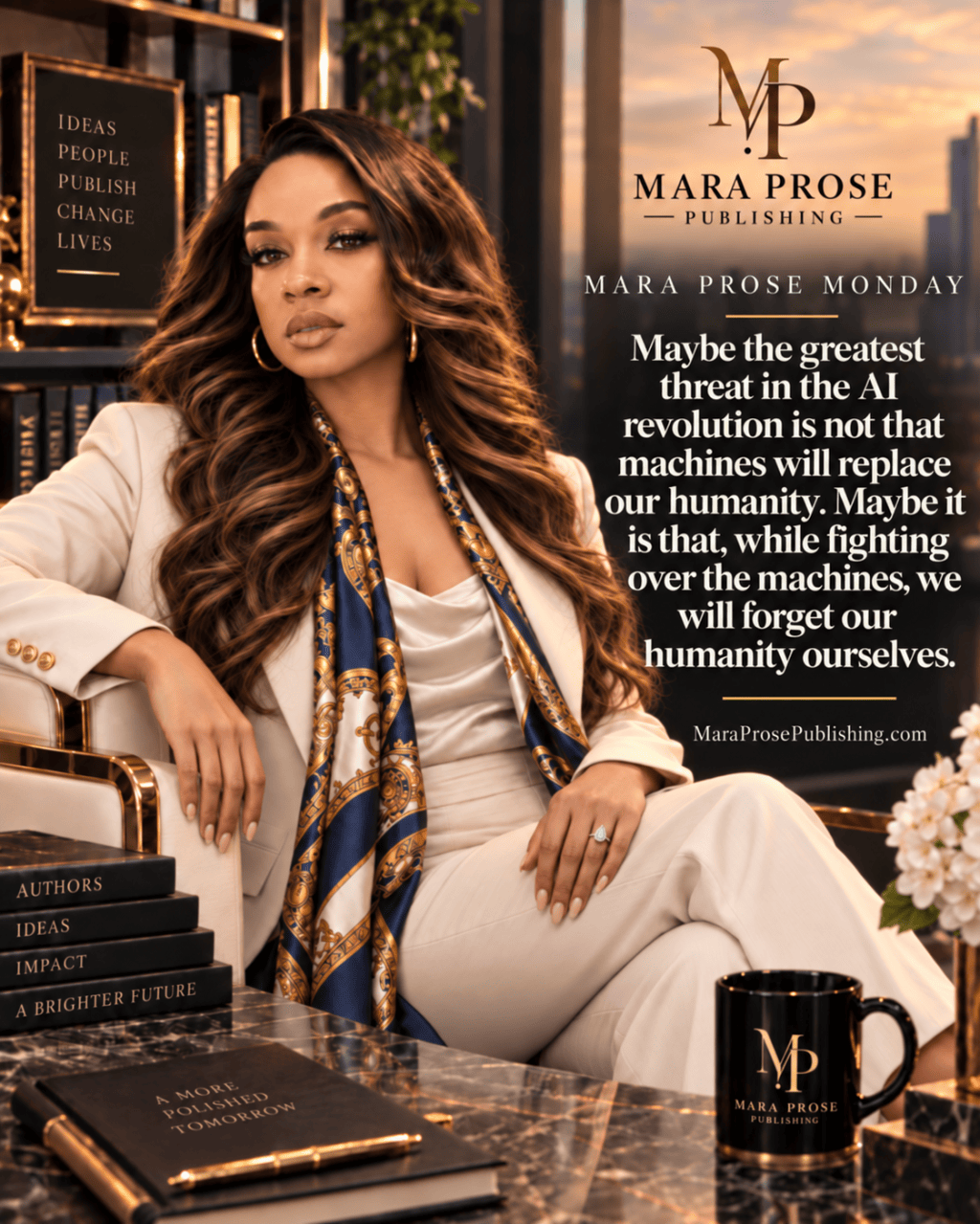
Maybe the greatest threat in the AI revolution is not that machines will replace our humanity. Maybe it is that, while fighting over the machines, we will forget our humanity ourselves.
That is the part I hope we figure out before it costs us even more.
Mara Prose is the founder of Mara Prose Publishing. Mara Prose Monday explores publishing, technology, business and the changing relationship between creativity and the tools shaping what comes next.


Leave a Reply